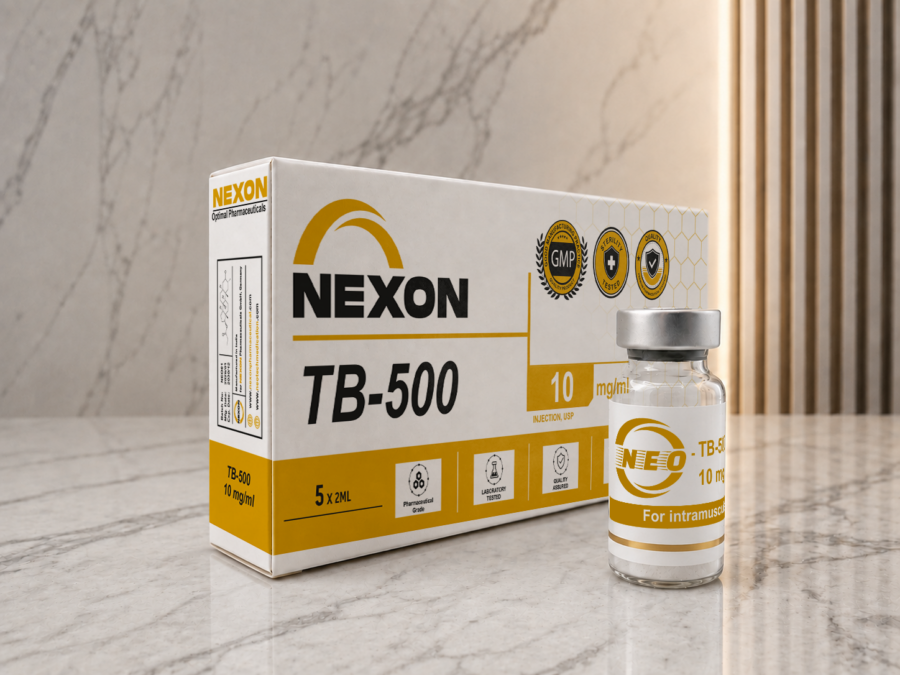
TB-500
TB-500 is a synthetic peptide associated with thymosin beta-4 (Tβ4), a naturally occurring peptide involved in cellular migration, tissue remodeling, angiogenesis, and wound-healin…
- Dosage Form / Route Investigational / Parenteral
- Drug Class Thymosin Beta-4–Related Peptide
Product Specifications
| Dosage Form / Route | Investigational / Parenteral |
|---|---|
| Composition | TB-500 |
| Drug Class | Thymosin Beta-4–Related Peptide |
This page is for product information only. NEXON does not sell products online through this website.
Scientific Profile
Detailed information
Introduction
TB-500 is a synthetic peptide associated with thymosin beta-4 (Tβ4), a naturally occurring peptide involved in cellular migration, tissue remodeling, angiogenesis, and wound-healing processes. It has attracted interest in experimental research because of its potential relationship with mechanisms involved in tissue repair and regeneration.
TB-500 is often discussed in connection with thymosin beta-4, but the terms should not automatically be treated as chemically identical. TB-500 refers to a synthetic peptide preparation marketed as being related to the active region of thymosin beta-4, while naturally occurring Tβ4 is a larger 43-amino-acid peptide.
Most evidence concerning TB-500 itself remains limited, and many proposed biological effects are derived from research on thymosin beta-4 rather than from extensive controlled human studies of TB-500.
NEXON
History
Thymosin beta-4 was originally identified as a naturally occurring peptide present in many tissues and biological fluids. Subsequent research demonstrated its involvement in cellular migration, actin regulation, angiogenesis, and tissue-repair processes. Researchers became interested in specific regions of thymosin beta-4 that appeared to contribute to its biological activity. TB-500 emerged as a synthetic peptide associated with this research and subsequently became widely investigated in experimental contexts involving tissue repair and regeneration. Despite substantial preclinical interest in thymosin beta-4 and related peptides, TB-500 has not been established as an approved therapeutic medication.
NEXON
Chemical Structure
- TB-500 is a synthetic peptide related to thymosin beta-4.
- Its research characteristics include:
- Synthetic peptide structure
- Related to thymosin beta-4 biology
- Investigated in cellular migration
- Associated with actin regulation
- Investigated in tissue-repair processes
- Studied in angiogenesis and wound-healing models
NEXON
Pharmacology
TB-500 is associated with biological pathways influenced by thymosin beta-4, particularly pathways involved in cell migration, cytoskeletal organization, angiogenesis, and tissue remodeling.
Thymosin beta-4 interacts with actin, an important structural protein involved in cellular movement and organization. Research suggests that Tβ4-related activity may influence cellular migration and the formation of new blood vessels during tissue-repair processes.
Because much of the mechanistic evidence comes from studies of thymosin beta-4 rather than extensive clinical studies of TB-500 itself, the exact pharmacology of TB-500 in humans remains incompletely established.
NEXON
Mechanism of Action
- Proposed mechanisms investigated in experimental research include:
- Regulation of actin dynamics
- Modulation of cellular migration
- Influence on endothelial-cell activity
- Promotion of angiogenic processes
- Modulation of inflammatory responses
- Support of extracellular-matrix remodeling
- Potential influence on wound-healing pathways
- These mechanisms remain primarily experimental and should not be interpreted as established therapeutic effects in
- humans.
- NEXON
Pharmacodynamics
Experimental research has investigated potential effects on:
- Fibroblast activity • Collagen-associated processes • Extracellular-matrix remodeling • Tissue regeneration
NEXON
Pharmacokinetics
The pharmacokinetic characteristics of TB-500 in humans have not been adequately established. As a peptide, its absorption, distribution, metabolism, and elimination are expected to depend substantially on its formulation and route of administration.
Importantly, pharmacokinetic information from studies of naturally occurring thymosin beta-4 should not automatically be presented as pharmacokinetic data for TB-500 itself.
A standardized clinical pharmacokinetic profile has not been established for TB-500.
NEXON
Physiological Effects
TB-500 is primarily investigated in relation to biological processes involved in tissue repair and regeneration. Research associated with thymosin beta-4 has examined regulation of actin dynamics, cellular migration, angiogenesis, extracellular- matrix remodeling, and inflammatory responses. These mechanisms are important components of normal wound healing and tissue remodeling.
Experimental studies have generated interest in potential applications involving connective tissue, vascular biology, and musculoskeletal repair. However, much of the available evidence is preclinical or relates to thymosin beta-4 rather than TB- 500 specifically. Consequently, clinically meaningful effects in humans remain uncertain and require further controlled research.
NEXON
Clinical Applications
- TB-500 has primarily been investigated in experimental contexts involving:
- Wound healing
- Tissue regeneration
- Tendon and ligament biology
- Musculoskeletal tissue repair
- Angiogenesis
- Cellular migration
- Connective-tissue remodeling
NEXON
Safety Considerations
The use of anabolic-androgenic steroids may require consideration of cardiovascular, hematological, hepatic, endocrine, metabolic, and reproductive health.
Important safety considerations include:
- Cardiovascular health
- Blood pressure
- Hematological parameters
- Lipid profile
- Liver function
- Endocrine function
- Reproductive function
- Prostate health
The overall safety profile depends on the specific compound, formulation, concentration, duration of exposure, individual response, and patient characteristics. Appropriate medical evaluation and regular monitoring should be considered when clinically indicated.
NEXON
Potential Adverse Effects
Potential adverse effects associated with anabolic-androgenic steroid exposure may involve endocrine, cardiovascular, hematological, hepatic, dermatological, reproductive, and metabolic systems.
- Endocrine Effects
- Suppression of endogenous hormone production
- Alterations in hormonal balance
- Changes in reproductive hormone signaling
- Potential suppression of spermatogenesis
- Cardiovascular Effects
- Changes in lipid profile
- Possible increases in blood pressure
- Potential cardiovascular risk
- Hematological Effects
- Changes in hematocrit
- Changes in hemoglobin
- Possible increase in erythropoietic activity
- Dermatological Effects
- Acne
- Increased sebaceous activity
- Androgen-related hair loss in genetically predisposed individuals
- Reproductive Effects
- Changes in reproductive function
- Potential reduction in fertility
- Alterations in reproductive hormone regulation
- Hepatic & Metabolic Effects
- Changes in liver function parameters
- Alterations in metabolic markers
- Changes in glucose and lipid metabolism
The occurrence and severity of adverse effects vary according to the specific compound, formulation, exposure, duration of use, individual response, and patient characteristics.
NEXON
Contraindications
Condition Reason Known hypersensitivity Risk of allergic reaction
Pregnancy Insufficient safety data Breastfeeding Insufficient safety data Active malignancy Effects involving angiogenic pathways require further investigation
Severe uncontrolled disease Safety and efficacy not established
NEXON
Drug Interactions
A comprehensive interaction profile may not be established for every anabolic-androgenic steroid or formulation.
- Potential interactions or clinical considerations may exist with:
- Anticoagulants
- Antidiabetic medications
- Hepatotoxic medications
- Other anabolic-androgenic steroids
- Other hormonal therapies
- Drugs affecting lipid metabolism
The clinical significance of potential interactions depends on the specific compound, formulation, dosage, duration of exposure, concomitant medications, and individual patient characteristics. Appropriate medical evaluation should be considered when multiple medications or hormonal therapies are used concurrently.
NEXON
Laboratory Monitoring
Laboratory Test Purpose CBC Monitor hematological parameters
ALT / AST Liver function
Bilirubin Hepatic assessment
Lipid Profile Cardiovascular risk assessment
Blood Pressure Cardiovascular monitoring
Total Testosterone Assess androgen status
LH / FSH Assess endocrine suppression
NEXON
Storage & Stability
- Store according to official product labeling.
- Protect from excessive heat and direct sunlight.
- Do not freeze.
- Maintain original packaging integrity.
- Keep away from children.
- Inspect packaging before use.
NEXON
Product Authenticity
Every genuine NEXON product should include appropriate quality verification features.
Authentication may include:
- Batch number tracking
- Manufacturing information
- Expiration date verification
- QR authentication system
- Authorized distribution verification
emphasizes transparency, traceability, and product quality control.
NEXON
Frequently Asked Questions
What is TB-500? TB-500 is a synthetic peptide associated with the biological activity of thymosin beta-4 and investigated primarily for tissue- repair and regenerative processes.
Is TB-500 a steroid? No. It is a synthetic peptide, not an anabolic steroid.
Is TB-500 a SARM? No. TB-500 does not belong to the SARM class.
Is TB-500 a growth hormone? No. TB-500 does not function as growth hormone or as a conventional GH secretagogue.
Is TB-500 the same as Thymosin Beta-4? They are related but should not automatically be considered chemically identical. TB-500 is generally described as a synthetic peptide related to thymosin beta-4, while naturally occurring thymosin beta-4 is a 43-amino-acid peptide.
Is TB-500 oral or injectable? TB-500 is primarily encountered as an investigational parenteral peptide, including injectable preparations.
NEXON
Quality Commitment
is committed to maintaining high standards of manufacturing quality, product consistency, traceability, and scientific transparency.
Through quality control systems, authentication procedures, and responsible information sharing, NEXON aims to provide reliable pharmaceutical products and educational resources for healthcare professionals and informed users.
NEXON
Related
More in this category
Tesamorelin
Tesamorelin is a synthetic analog of growth hormone-releasing hormone (GHRH) that stimulates the pituitary gland to increase endogenous growth hormone secretion. Rather than direct…

PEG MGF
PEG-MGF, or Pegylated Mechano Growth Factor, is an investigational synthetic peptide associated with Mechano Growth Factor (MGF), a locally expressed splice variant related to the…

MGF
MGF, or Mechano Growth Factor, is a term associated with a locally expressed splice variant of the insulin-like growth factor- 1 (IGF-1) gene that has been investigated in skeletal…