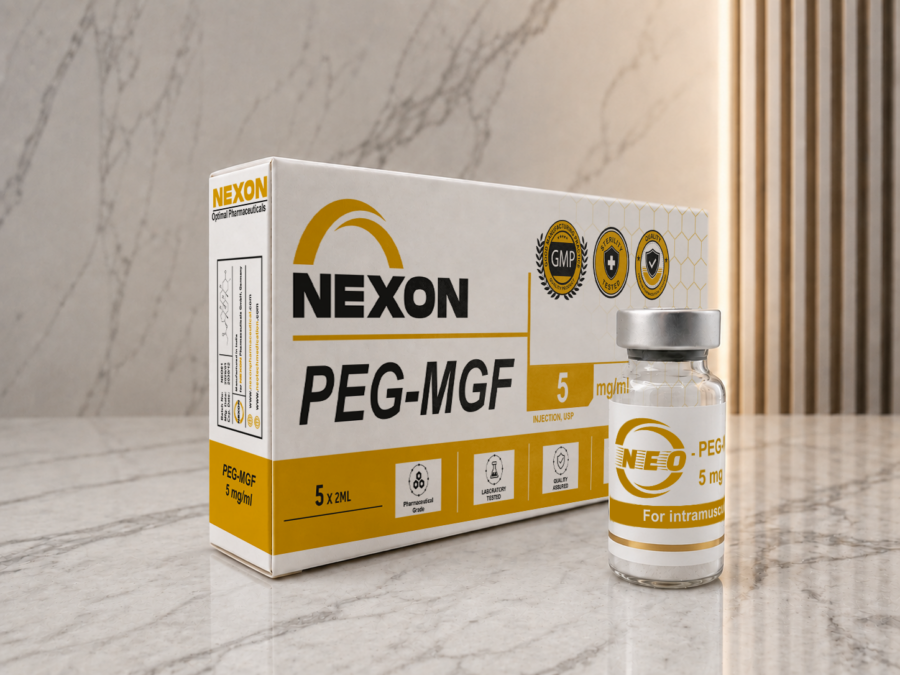
PEG MGF
PEG-MGF, or Pegylated Mechano Growth Factor, is an investigational synthetic peptide associated with Mechano Growth Factor (MGF), a locally expressed splice variant related to the…
- Dosage Form / Route Investigational / Parenteral
- Drug Class IGF-1–Related Synthetic Peptide
Product Specifications
| Dosage Form / Route | Investigational / Parenteral |
|---|---|
| Composition | PEG-MGF |
| Drug Class | IGF-1–Related Synthetic Peptide |
This page is for product information only. NEXON does not sell products online through this website.
Scientific Profile
Detailed information
Introduction
PEG-MGF, or Pegylated Mechano Growth Factor, is an investigational synthetic peptide associated with Mechano Growth Factor (MGF), a locally expressed splice variant related to the insulin-like growth factor-1 (IGF-1) system. MGF has attracted research interest because its expression has been associated with mechanical stress, skeletal-muscle injury, and tissue-repair responses.
PEG-MGF incorporates polyethylene glycol (PEG) modification intended to alter the stability and pharmacokinetic behavior of the peptide. However, commercially described PEG-MGF preparations have not been established as approved therapeutic medicines, and their biological effects, pharmacokinetics, and long-term safety in humans remain insufficiently characterized.
NEXON
History
Research into MGF developed from studies of the IGF-1 gene and its alternative splice variants in skeletal muscle. Investigators observed that mechanical loading and muscle injury could alter local IGF-1-related gene expression, leading to interest in a splice variant commonly referred to as Mechano Growth Factor.
PEG-MGF subsequently emerged as an experimental attempt to modify an MGF-related peptide through pegylation, theoretically increasing stability and prolonging systemic persistence. Despite substantial interest in experimental and performance-related contexts, PEG-MGF has not developed into an established FDA-approved human therapeutic product.
NEXON
Chemical Structure
PEG-MGF is generally described as a pegylated synthetic peptide associated with the MGF/IGF-1 system. Pegylation involves attachment of polyethylene glycol (PEG) to a peptide molecule, a modification commonly used experimentally to alter molecular stability, degradation, and pharmacokinetic behavior.
The PEG component distinguishes PEG-MGF from non-pegylated MGF-related peptides. However, the exact molecular identity and characterization of products sold under the name PEG-MGF may vary, and a standardized approved pharmaceutical structure has not been established.
NEXON
Pharmacology
PEG-MGF is associated with research into MGF-related signaling following mechanical stress and skeletal-muscle injury. Endogenous MGF-related expression has been investigated as part of the local molecular response to muscle loading, damage, and subsequent tissue remodeling.
The PEG modification is intended to improve peptide stability and potentially extend biological persistence. However, pharmacological observations concerning endogenous MGF cannot automatically be attributed to exogenously administered PEG-MGF, and its precise pharmacological activity in humans remains insufficiently characterized.
NEXON
Mechanism of Action
Proposed mechanisms investigated in MGF-related research include:
- Modulation of local growth-factor signaling
- Influence on cellular responses following mechanical stress
- Potential regulation of satellite-cell activity
- Support of muscle-repair signaling
- Modulation of tissue-remodeling pathways
- Potential involvement in regenerative cellular responses
- Increased molecular persistence through PEG modification
NEXON
Pharmacodynamics
PEG-MGF is primarily associated with experimental research involving growth-factor signaling and skeletal-muscle responses.
NEXON
Pharmacokinetics
Reliable human pharmacokinetic information for PEG-MGF remains limited. Pegylation is generally used to increase molecular size and reduce susceptibility to rapid enzymatic degradation, potentially producing greater persistence than an equivalent non-pegylated peptide.
However, these general properties of pegylation do not establish a specific clinical half-life for PEG-MGF. Standardized data covering absorption, distribution, metabolism, elimination, and duration of biological activity have not been established for an approved human formulation.
NEXON
Physiological Effects
PEG-MGF is primarily associated with experimental investigation of skeletal-muscle repair, growth-factor signaling, and cellular responses following mechanical stress. MGF-related expression has been observed following muscle loading and injury, leading to research into its possible involvement in satellite-cell activity, muscle regeneration, cellular proliferation, and tissue remodeling. Pegylation is intended to increase the stability and persistence of an MGF-related peptide compared with an unmodified form. However, biological effects observed with endogenous MGF cannot automatically be extrapolated to externally administered PEG-MGF. Controlled human evidence remains very limited, and proposed effects involving muscle growth, accelerated recovery, or enhanced tissue regeneration have not been established as clinical outcomes. PEG-MGF therefore remains an experimental growth-factor-related peptide rather than an established regenerative therapy.
NEXON
Clinical Applications
Research surrounding MGF-related biology has primarily focused on skeletal-muscle adaptation, responses to mechanical loading, muscle injury, tissue repair, satellite-cell biology, and regeneration. These mechanisms have generated scientific interest in potential future applications involving muscle-wasting conditions and regenerative medicine.
PEG-MGF itself, however, has no established approved clinical indication. Adequate controlled human trials have not demonstrated it as an approved treatment for muscle injury, muscle-wasting disorders, impaired recovery, or enhancement of muscle growth.
NEXON
Safety Considerations
The use of anabolic-androgenic steroids may require consideration of cardiovascular, hematological, hepatic, endocrine, metabolic, and reproductive health.
Important safety considerations include:
- Cardiovascular health
- Blood pressure
- Hematological parameters
- Lipid profile
- Liver function
- Endocrine function
- Reproductive function
- Prostate health
The overall safety profile depends on the specific compound, formulation, concentration, duration of exposure, individual response, and patient characteristics. Appropriate medical evaluation and regular monitoring should be considered when clinically indicated.
NEXON
Potential Adverse Effects
Potential adverse effects associated with anabolic-androgenic steroid exposure may involve endocrine, cardiovascular, hematological, hepatic, dermatological, reproductive, and metabolic systems.
- Endocrine Effects
- Suppression of endogenous hormone production
- Alterations in hormonal balance
- Changes in reproductive hormone signaling
- Potential suppression of spermatogenesis
- Cardiovascular Effects
- Changes in lipid profile
- Possible increases in blood pressure
- Potential cardiovascular risk
- Hematological Effects
- Changes in hematocrit
- Changes in hemoglobin
- Possible increase in erythropoietic activity
- Dermatological Effects
- Acne
- Increased sebaceous activity
- Androgen-related hair loss in genetically predisposed individuals
- Reproductive Effects
- Changes in reproductive function
- Potential reduction in fertility
- Alterations in reproductive hormone regulation
- Hepatic & Metabolic Effects
- Changes in liver function parameters
- Alterations in metabolic markers
- Changes in glucose and lipid metabolism
The occurrence and severity of adverse effects vary according to the specific compound, formulation, exposure, duration of use, individual response, and patient characteristics.
NEXON
Contraindications
Condition Reason Pregnancy Insufficient safety data Breastfeeding Insufficient safety data Known Hypersensitivity Potential allergic reaction Active Malignancy Theoretical concern involving growth-factor signaling
Significant Uncontrolled Disease Safety and efficacy not established
NEXON
Drug Interactions
A comprehensive interaction profile may not be established for every anabolic-androgenic steroid or formulation.
- Potential interactions or clinical considerations may exist with:
- Anticoagulants
- Antidiabetic medications
- Hepatotoxic medications
- Other anabolic-androgenic steroids
- Other hormonal therapies
- Drugs affecting lipid metabolism
The clinical significance of potential interactions depends on the specific compound, formulation, dosage, duration of exposure, concomitant medications, and individual patient characteristics. Appropriate medical evaluation should be considered when multiple medications or hormonal therapies are used concurrently.
NEXON
Laboratory Monitoring
Laboratory Test Purpose CBC Monitor hematological parameters
ALT / AST Liver function
Bilirubin Hepatic assessment
Lipid Profile Cardiovascular risk assessment
Blood Pressure Cardiovascular monitoring
Total Testosterone Assess androgen status
LH / FSH Assess endocrine suppression
NEXON
Storage & Stability
- Store according to official product labeling.
- Protect from excessive heat and direct sunlight.
- Do not freeze.
- Maintain original packaging integrity.
- Keep away from children.
- Inspect packaging before use.
NEXON
Product Authenticity
Every genuine NEXON product should include appropriate quality verification features.
Authentication may include:
- Batch number tracking
- Manufacturing information
- Expiration date verification
- QR authentication system
- Authorized distribution verification
emphasizes transparency, traceability, and product quality control.
NEXON
Frequently Asked Questions
What is PEG-MGF? PEG-MGF stands for Pegylated Mechano Growth Factor, an investigational peptide associated with MGF/IGF-1-related biology.
What does PEG mean? PEG means polyethylene glycol. Pegylation is a molecular modification used to alter properties such as peptide stability and persistence.
Is PEG-MGF the same as IGF-1? No. PEG-MGF is associated with MGF-related biology originating from IGF-1 alternative-splicing research, but it is not chemically identical to conventional IGF-1.
Is PEG-MGF a steroid? No. It is a growth-factor-related investigational peptide, not an anabolic-androgenic steroid.
Is PEG-MGF a SARM? No. PEG-MGF does not belong to the selective androgen receptor modulator class.
What is PEG-MGF primarily researched for? Research interest primarily concerns skeletal-muscle repair, regeneration, satellite-cell biology, and responses to mechanical stress.
NEXON
Quality Commitment
is committed to maintaining high standards of manufacturing quality, product consistency, traceability, and scientific transparency.
Through quality control systems, authentication procedures, and responsible information sharing, NEXON aims to provide reliable pharmaceutical products and educational resources for healthcare professionals and informed users.
NEXON
Related
More in this category
Tesamorelin
Tesamorelin is a synthetic analog of growth hormone-releasing hormone (GHRH) that stimulates the pituitary gland to increase endogenous growth hormone secretion. Rather than direct…
TB-500
TB-500 is a synthetic peptide associated with thymosin beta-4 (Tβ4), a naturally occurring peptide involved in cellular migration, tissue remodeling, angiogenesis, and wound-healin…
MGF
MGF, or Mechano Growth Factor, is a term associated with a locally expressed splice variant of the insulin-like growth factor- 1 (IGF-1) gene that has been investigated in skeletal…