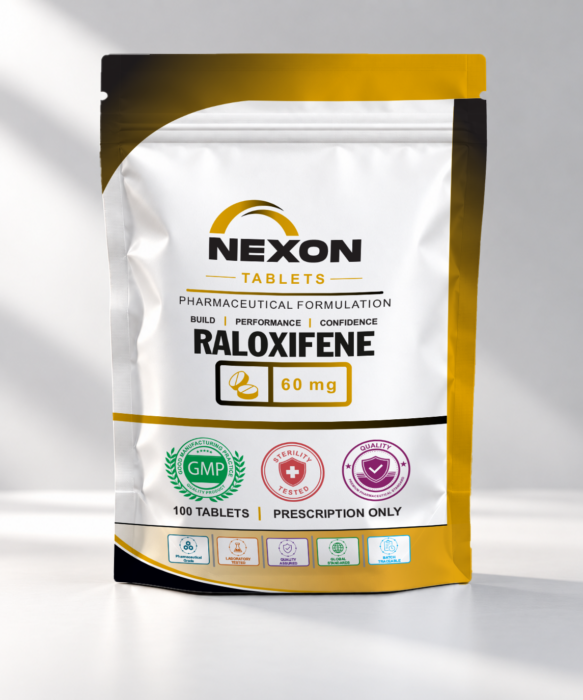
Raloxifene 60 mg
Raloxifene hydrochloride is an orally active selective estrogen receptor modulator. Each tablet in this fictional NEXON catalog presentation contains 60 mg of raloxifene hydrochlor…
- Dosage Form / Route Oral Administration
- Drug Class Selective Estrogen Receptor Modulator
Product Specifications
| Dosage Form / Route | Oral Administration |
|---|---|
| Composition | Raloxifene Hydrochloride (C28H27NO4S·HCl) |
| Drug Class | Selective Estrogen Receptor Modulator |
| Chemical Formula | C28H27NO4S·HCl |
This page is for product information only. NEXON does not sell products online through this website.
Scientific Profile
Detailed information
Introduction
Raloxifene hydrochloride is an orally active selective estrogen receptor modulator. Each tablet in this fictional NEXON catalog presentation contains 60 mg of raloxifene hydrochloride.
Its tissue-selective actions include estrogen-like effects on bone and antagonism of estrogen signaling in breast tissue. It is not an estrogen replacement or treatment for established breast cancer.
History
Raloxifene emerged from research into tissue-selective estrogen receptor modulators and entered clinical use in the late 1990s for prevention and treatment of postmenopausal osteoporosis.
The 60 mg oral tablet became an established pharmaceutical presentation. This displayed product is a fictional NEXON website catalog item rather than a claim regarding a specific approved medicine.
Approved indications, prescribing requirements, contraindications, legal classification, and availability depend on the jurisdiction and the exact manufactured product.
Chemical Structure
Raloxifene hydrochloride is a benzothiophene-derived compound. Its hydrochloride salt has the formula C28H27NO4S·HCl and an approximate molar mass of 510.05 g/mol.
NEXON • ESTROGEN CONTROL & HORMONAL SUPPORT • 2 The nonsteroidal structure binds estrogen receptors and produces different responses by tissue. Tablets contain the hydrochloride salt; the labeled 60 mg refers to that salt in this presentation.
- Nonsteroidal benzothiophene framework
- Hydrochloride salt pharmaceutical form
- Selective estrogen-receptor modulation
- Tissue-dependent agonist and antagonist effects
- Oral tablet formulation
Pharmacology
After oral administration, raloxifene is absorbed through the gastrointestinal tract. It binds estrogen receptors and regulates transcription differently according to tissue-specific coregulators and physiological context.
In bone, it reduces resorption and helps preserve mineral density in postmenopausal women. In breast tissue, it antagonizes estrogen-responsive pathways without directly inhibiting aromatase. Oral Raloxifene → Gastrointestinal Absorption → Estrogen Receptor Binding → Tissue-Selective Signaling
Raloxifene is not an anabolic-androgenic steroid, aromatase inhibitor, or treatment for existing invasive breast cancer. Its clinical balance must account for venous thromboembolism and stroke risk. NEXON • ESTROGEN CONTROL & HORMONAL SUPPORT • 3
Mechanism of Action
The primary mechanism involves:
- Disintegration and dissolution of the oral tablet
- Gastrointestinal absorption of active raloxifene
- Estrogen-receptor binding in target tissues
- Tissue-specific coregulator recruitment
- Reduced osteoclast-driven bone resorption
- Antagonism of estrogen signaling in breast tissue
- Glucuronidation and predominantly fecal elimination
- Raloxifene changes tissue response to estrogen rather than globally suppressing estrogen production.
- Benefits and risks differ across bone, breast, uterine, and vascular tissues.
Pharmacodynamics
- Selective estrogen-receptor binding
- Reduced bone turnover and resorption
- Maintenance of postmenopausal bone density
- Antagonism of breast estrogen signaling
- Limited endometrial stimulation
- Effects on coagulation and vascular physiology
- Lipid and metabolic changes
- Secondary estrogen-responsive effects
ESTROGEN BIOSYNTHESIS Raloxifene does not directly inhibit aromatase or estrogen biosynthesis, but may influence estrogen- responsive physiology through:
- Estrogen-receptor occupancy in bone
- Reduced estrogen signaling in breast tissue
- Tissue-specific agonist and antagonist activity
- Altered transcription of estrogen-responsive genes
- Reduced bone resorption in postmenopause
- Changes in endocrine and vascular pathways
- The magnitude of response depends on adherence, menopausal status, baseline bone and vascular
- health, concurrent therapy, and individual physiology.
Pharmacokinetics
Following oral administration, raloxifene is absorbed, but extensive first-pass glucuronidation limits systemic bioavailability. Exposure depends on absorption, hepatic function, interacting substances, and individual physiology.
Raloxifene and its glucuronide conjugates undergo enterohepatic cycling. The compound is highly protein bound and is not principally metabolized through cytochrome P450 pathways.
Elimination occurs primarily through feces, with little urinary excretion. Bile-acid sequestrants can substantially reduce absorption and should not be co-administered according to labeling.
The complete pharmacokinetic profile of this fictional 60 mg tablet depends on the validated formulation and has not been established through independent product-specific clinical studies.
Physiological Effects
Through tissue-selective estrogen-receptor modulation, raloxifene may influence bone turnover, postmenopausal vertebral fracture risk, estrogen-responsive breast tissue, lipid parameters, thermoregulation, coagulation, and vascular physiology.
NEXON • ESTROGEN CONTROL & HORMONAL SUPPORT • 5 Its effects differ from estrogen therapy because breast and uterine responses are not uniformly estrogenic, and from aromatase inhibitors because it does not globally reduce estrogen synthesis.
Inappropriate use can expose individuals to clinically significant harms, particularly venous thrombosis, pulmonary embolism, retinal vein thrombosis, and fatal stroke in susceptible populations.
Clinical Applications
Approved raloxifene products are used for treatment and prevention of osteoporosis in postmenopausal women and for reduction of invasive breast cancer risk in specified postmenopausal groups.
Raloxifene does not treat existing breast cancer or prevent noninvasive breast cancer. Clinical use requires an approved product, indication and risk assessment, contraindication review, and monitoring.
The displayed 60 mg tablet is a fictional NEXON catalog item and should not be interpreted as an independently approved medicinal product.
Safety Considerations
Raloxifene exposure requires consideration of venous thromboembolism, stroke, cardiovascular, skeletal, hepatic, reproductive, vasomotor, and medication-related risks.
Important safety considerations include:
- Prior or active venous thromboembolism
- Deep vein, pulmonary, or retinal vein thrombosis
- Stroke and coronary-risk factors
- Periods of immobilization
- Pregnancy and breastfeeding status
- Postmenopausal status
- Bone health and fracture history
- Hot flashes and leg cramps
- Oral formulation tolerability
- Bile-acid sequestrant and other medication review
- The safety profile depends on indication, duration, baseline vascular and skeletal health, individual
- response, and concurrent therapy. Medical supervision is essential whenever raloxifene is prescribed.
- Raloxifene should generally be stopped before and during prolonged immobilization under clinician
- direction. Unsupervised use to manipulate estrogen signaling cannot replace individualized risk
- assessment.
Potential Adverse Effects
Potential adverse effects may involve thromboembolic, cardiovascular, vasomotor, musculoskeletal, gastrointestinal, dermatological, reproductive, neurological, and psychological systems.
- Endocrine and Vasomotor Effects
- Hot flashes or worsening vasomotor symptoms
- Changes in estrogen-receptor signaling
- Altered postmenopausal tissue response
- Peripheral edema
- NEXON • ESTROGEN CONTROL & HORMONAL SUPPORT • 6
- • Sweating
- Changes in comfort or sexual function
- Cardiovascular and Metabolic Effects
- Deep vein thrombosis
- Pulmonary or retinal vein thrombosis
- Potentially fatal stroke in susceptible women
- Changes in lipid parameters
- Peripheral edema
- Skeletal and Musculoskeletal Effects
- Leg cramps
- Arthralgia or joint discomfort
- Muscle pain or stiffness
- Bone-health changes despite treatment
- Dermatological Effects
- Rash
- Pruritus
- Sweating
- Rare skin reactions
- Hypersensitivity reactions
- Reproductive Effects
- Potential fetal harm
- Inappropriate use before menopause
- Vaginal bleeding requiring evaluation
- Effects on estrogen-responsive tissues
- Changes in sexual comfort
- Hepatic and Neurological Effects
- Changes in liver-function parameters
- Possible altered exposure in liver disease
- Headache
- Dizziness or sleep disturbance
- Stroke warning signs requiring urgent care
- Oral Formulation Related Effects
- Gastrointestinal discomfort
- Nausea or dyspepsia
- Hypersensitivity to raloxifene or excipients
- Tablet intolerance related to formulation ingredients
- Medication errors involving strength or frequency
- The occurrence and severity of adverse effects vary with exposure, duration, underlying vascular risks,
- individual response, and concurrent medications.
NEXON • ESTROGEN CONTROL & HORMONAL SUPPORT • 7
Contraindications
Condition Reason
Active or Previous Venous Thromboembolism Risk of recurrent venous clotting
Deep Vein Thrombosis History Prior deep vein clot is a labeled exclusion
Pulmonary Embolism History Prior pulmonary clot is a labeled exclusion
Retinal Vein Thrombosis History Prior retinal venous clot is a labeled exclusion
Pregnancy Potential fetal harm; no indicated benefit
Women Who May Become Pregnant Not intended for premenopausal use
Breastfeeding Potential infant exposure; contraindicated in labeling
Known Hypersensitivity Risk of allergic reaction to raloxifene or excipients
Drug Interactions
Potential interactions or important clinical considerations may exist with:
- Bile-acid sequestrants such as cholestyramine
- Warfarin and other anticoagulants
- Systemic estrogen therapies
- Highly protein-bound medicines
- Medicines affecting thrombotic risk
- Other osteoporosis therapies
- Hormonal therapies
- Drugs affecting hepatic or biliary function
- Laboratory tests influenced by hormonal status
- Bile-acid sequestrants markedly reduce raloxifene absorption; anticoagulant monitoring may be needed
- when medicines are started or stopped. Other interactions require review of the exact treatment plan.
NEXON • ESTROGEN CONTROL & HORMONAL SUPPORT • 8
Laboratory Monitoring
Laboratory Test Purpose
Bone Mineral Density Assess baseline and treatment-related skeletal health
Calcium / Vitamin D Status Support bone-health management
Clinical VTE Review Assess signs and risk factors for venous thrombosis
Stroke Risk Assessment Review cardiovascular and cerebrovascular risk
Blood Pressure Cardiovascular-risk monitoring
Lipid Profile Assess underlying metabolic risk
ALT / AST Evaluate liver function when clinically relevant
Pregnancy Testing Exclude pregnancy when status is uncertain
Medication Interaction Review Review anticoagulants, estrogen, and bile-acid sequestrants
Breast Health Assessment Follow indicated screening and risk-reduction plan
Clinical Symptom Review Monitor hot flashes, leg cramps, edema, and vascular symptoms
Storage & Stability
- Store according to official product labeling.
- Protect from excessive heat, moisture, and direct sunlight.
- Keep the container tightly closed.
- Maintain original packaging integrity.
- Keep away from children.
- Inspect tablets and packaging before use.
- Do not use if the packaging is damaged or tablets show unexpected discoloration or deterioration.
- Storage requirements depend on the validated tablet formulation.
Product Authenticity
Every genuine NEXON product should include appropriate quality-verification features.
- Batch-number tracking
- Manufacturing information
- Expiration-date verification
- QR authentication system
- Tamper-evident packaging
- Authorized-distribution verification
- NEXON emphasizes transparency, traceability, and product-quality control.
NEXON • ESTROGEN CONTROL & HORMONAL SUPPORT • 9
Frequently Asked Questions
What is Raloxifene 60 mg? It is a fictional oral tablet presentation containing 60 mg of raloxifene hydrochloride per tablet.
What class of medicine is raloxifene? It is a selective estrogen receptor modulator with tissue-specific agonist and antagonist effects.
What does 60 mg represent? It is the labeled amount of raloxifene hydrochloride contained in each tablet.
Is raloxifene an anabolic steroid? No. It is a selective estrogen receptor modulator, not an anabolic-androgenic steroid.
Is raloxifene an aromatase inhibitor? No. It modulates estrogen receptors rather than directly inhibiting estrogen synthesis.
Is it oral or injectable? This product is presented as an oral tablet.
Does raloxifene treat breast cancer? No. Approved use includes risk reduction in certain postmenopausal women, not treatment of established breast cancer.
Can raloxifene cause serious adverse effects? Yes. It increases venous thromboembolism risk and may increase the risk of fatal stroke in susceptible women.
Does raloxifene require medical supervision? Yes. Indication, menopausal status, vascular risk, contraindications, interactions, and monitoring need clinical review.
Is this specific NEXON 60 mg formulation FDA approved? No. The displayed 60 mg tablet is a fictional catalog item and is not presented as an independently FDA- approved medicine.
Quality Commitment
is committed to maintaining high standards of manufacturing quality, product consistency, traceability, and scientific transparency.
Through quality-control systems, authentication procedures, and responsible information sharing, NEXON aims to provide reliable pharmaceutical products and educational resources for healthcare professionals and informed users.
NEXON • ESTROGEN CONTROL & HORMONAL SUPPORT • 10
Related
More in this category

Creatine Formula
Creatine Formula is an oral sports-nutrition preparation centered on creatine, a naturally occurring compound involved in rapid cellular energy regeneration. Creatine is stored pre…

Beta-Alanine
Beta-Alanine is a naturally occurring non-proteinogenic amino acid that serves as an important precursor for synthesis of carnosine in skeletal muscle. Unlike conventional alpha-am…

Branched-Chain Amino Acid Formula
Branched-Chain Amino Acids are a group of three essential amino acids consisting of L-leucine, L-isoleucine and L-valine. Their characteristic branched molecular structures disting…