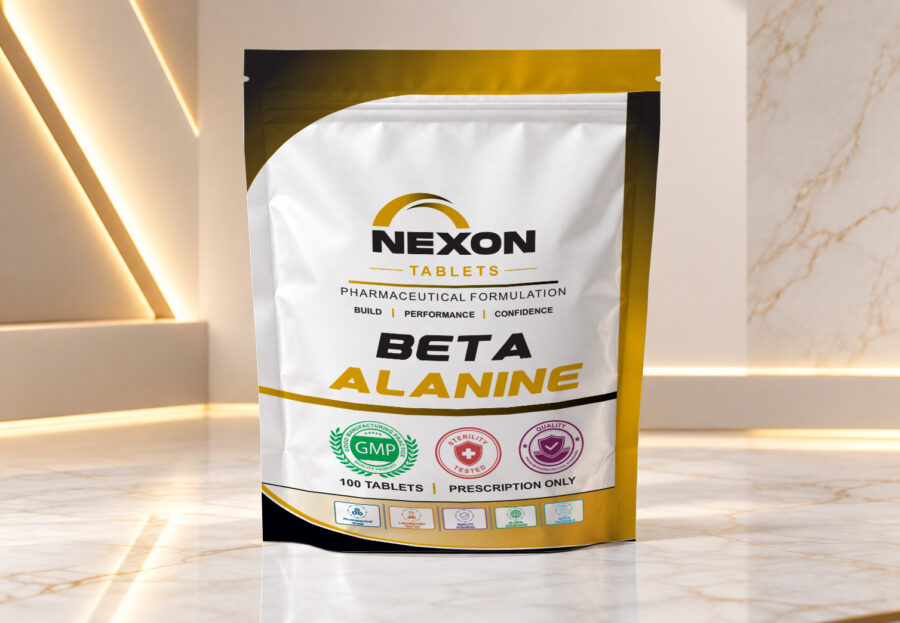
Beta-Alanine
Beta-Alanine is a naturally occurring non-proteinogenic amino acid that serves as an important precursor for synthesis of carnosine in skeletal muscle. Unlike conventional alpha-am…
- Dosage Form / Route Oral Administration
- Drug Class Amino Acid / Sports Nutrition Supplement
Product Specifications
| Dosage Form / Route | Oral Administration |
|---|---|
| Composition | Beta-Alanine |
| Drug Class | Amino Acid / Sports Nutrition Supplement |
This page is for product information only. NEXON does not sell products online through this website.
Scientific Profile
Detailed information
Introduction
Beta-Alanine is a naturally occurring non-proteinogenic amino acid that serves as an important precursor for synthesis of carnosine in skeletal muscle. Unlike conventional alpha-amino acids used directly in protein synthesis, beta-alanine primarily contributes to physiological function through formation of carnosine, an intracellular dipeptide involved in acid- base regulation during muscular activity.
NEXON
History
Scientific interest in beta-alanine increased substantially after research demonstrated that oral supplementation could elevate skeletal muscle carnosine concentrations. This finding established beta-alanine as an important sports-nutrition compound and led to extensive investigation of its effects on high-intensity exercise, muscular fatigue and intracellular buffering capacity.
NEXON
Chemical Structure
Beta-Alanine is structurally distinct from alpha-alanine because its amino group is attached to the beta carbon rather than the alpha carbon. Its molecular formula is C3H7NO2. This structural arrangement classifies beta-alanine as a beta-amino acid and explains why it is not incorporated into proteins through conventional ribosomal protein synthesis.
NEXON
Pharmacology
The principal physiological effect of supplemental beta-alanine is elevation of intramuscular carnosine concentrations. Carnosine is concentrated particularly within skeletal muscle and contributes to intracellular proton buffering, calcium- related muscular processes and other aspects of muscle physiology. Beta-alanine supplementation therefore acts primarily through gradual modification of the muscle carnosine pool rather than through an immediate stimulant-like effect.
NEXON
Mechanism of Action
Following absorption, beta-alanine becomes available to skeletal muscle and combines with histidine to form carnosine. During high-intensity muscular activity, hydrogen-ion accumulation contributes to reductions in intracellular pH. Carnosine can accept hydrogen ions and therefore contributes to intracellular buffering, helping regulate the muscle environment during intense exercise.
NEXON
Pharmacodynamics
Repeated beta-alanine supplementation increases skeletal muscle carnosine content over time. The resulting increase in intracellular buffering capacity may influence fatigue resistance during exercise characterized by substantial glycolytic demand and hydrogen-ion accumulation. Its physiological effects therefore depend more strongly on sustained elevation of muscle carnosine than on the circulating beta-alanine concentration from a single administration.
NEXON
Pharmacokinetics
Following oral administration, beta-alanine is absorbed from the gastrointestinal tract and enters systemic circulation before uptake and metabolism by tissues. In skeletal muscle, it serves as a substrate for carnosine synthesis together with histidine. Circulating beta-alanine itself is relatively transient, whereas the physiologically relevant increase in intramuscular carnosine develops progressively and can persist beyond the immediate period of supplementation.
Physiological Effects
The primary physiological effect of beta-alanine supplementation is increased tissue availability for carnosine synthesis. Higher intramuscular carnosine concentrations contribute to proton buffering and may influence muscle contractile physiology. These mechanisms have generated particular interest in exercise involving substantial anaerobic and glycolytic energy demands.
NEXON
Clinical Applications
Beta-Alanine is primarily investigated and used within sports nutrition rather than as a conventional therapeutic drug. Research has focused on exercise performance, muscular endurance, fatigue resistance and muscle carnosine metabolism. Potential applications outside sports performance remain areas of scientific investigation and should not be interpreted as established therapeutic indications.
NEXON
Safety Considerations
Beta-Alanine has been extensively studied in healthy exercising populations and is generally well tolerated under investigated conditions. One characteristic response is transient paresthesia, which may present as tingling, prickling or unusual skin sensation. This effect is typically associated with acute exposure and does not by itself indicate an allergic reaction.
NEXON
Potential Adverse Effects
The best-characterized adverse effect is temporary paresthesia, commonly experienced as tingling or prickling sensations involving the skin. Gastrointestinal discomfort may also occur in some individuals. Tolerability varies according to formulation, administration pattern and individual sensitivity.
NEXON
Contraindications
Individuals with known hypersensitivity to formulation components or significant underlying medical conditions should receive appropriate professional assessment before supplementation. Pregnancy, breastfeeding and clinically significant renal, hepatic or metabolic conditions require individualized consideration because evidence in these populations may be limited.
NEXON
Drug Interactions
Beta-Alanine does not have a broad established drug-interaction profile comparable with conventional pharmaceutical agents. Nevertheless, medication use and underlying medical conditions should be considered when evaluating supplementation. Interaction considerations may also depend on additional ingredients when beta-alanine is incorporated into a multi-component sports-nutrition formula.
NEXON
Laboratory Monitoring
Routine laboratory monitoring is generally unnecessary for conventional sports-nutrition use in healthy individuals. In research environments, muscle carnosine concentrations may be evaluated using specialized analytical techniques. Additional laboratory testing should be determined by individual health status rather than beta-alanine supplementation alone.
NEXON
Storage & Stability
Beta-Alanine powder should be stored in a cool, dry environment according to validated product-specific stability information. The formulation should be protected from excessive moisture, heat and inappropriate environmental exposure. Packaging should remain securely closed to preserve powder characteristics and product integrity.
NEXON
Product Authenticity
Product authenticity should be confirmed through batch identification, packaging integrity, traceability systems and appropriate quality-control documentation. Verification of raw-material identity, purity and compositional consistency is particularly important for single-ingredient sports-nutrition formulations.
NEXON
Frequently Asked Questions
Beta-Alanine is not the same compound as L-Alanine and is not a BCAA or EAA formulation. Its primary sports-nutrition function is to increase skeletal muscle carnosine rather than directly provide amino-acid substrates for muscle protein synthesis. Its effects also differ from those of creatine: creatine primarily supports rapid cellular energy regeneration through the phosphocreatine system, whereas beta-alanine primarily influences muscle carnosine and intracellular buffering.
NEXON
Quality Commitment
is committed to maintaining high standards of manufacturing quality, product consistency, traceability, and scientific transparency. Through appropriate quality-control systems, authentication procedures, manufacturing oversight, and responsible information sharing, NEXON aims to provide reliable nutritional products and educational information for healthcare professionals, athletes, and informed users. For oral powder formulations, particular emphasis is placed on active-ingredient identity, purity, content uniformity, product stability, manufacturing consistency, and batch-to-batch quality control.
NEXON
Related
More in this category
Creatine Formula
Creatine Formula is an oral sports-nutrition preparation centered on creatine, a naturally occurring compound involved in rapid cellular energy regeneration. Creatine is stored pre…
Branched-Chain Amino Acid Formula
Branched-Chain Amino Acids are a group of three essential amino acids consisting of L-leucine, L-isoleucine and L-valine. Their characteristic branched molecular structures disting…
Tamoxifen Citrate 20 mg
Tamoxifen citrate is an orally active, nonsteroidal selective estrogen receptor modulator. Each tablet in this fictional NEXON catalog presentation provides tamoxifen citrate equiv…