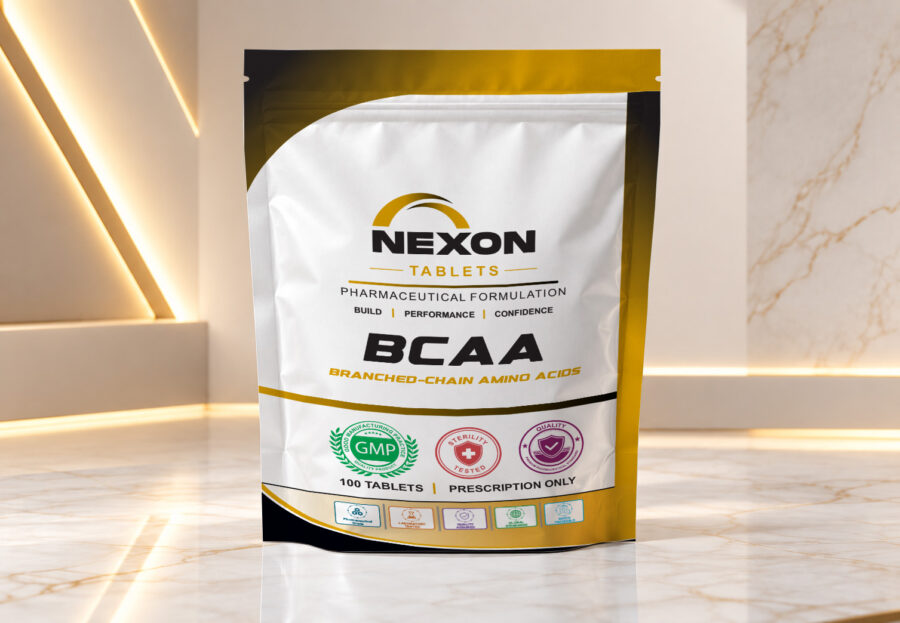
Branched-Chain Amino Acid Formula
Branched-Chain Amino Acids are a group of three essential amino acids consisting of L-leucine, L-isoleucine and L-valine. Their characteristic branched molecular structures disting…
- Dosage Form / Route Oral Administration
- Drug Class Amino Acid / Sports Nutrition Supplement
Product Specifications
| Dosage Form / Route | Oral Administration |
|---|---|
| Composition | L-Leucine, L-Isoleucine and L-Valine |
| Drug Class | Amino Acid / Sports Nutrition Supplement |
This page is for product information only. NEXON does not sell products online through this website.
Scientific Profile
Detailed information
Introduction
Branched-Chain Amino Acids are a group of three essential amino acids consisting of L-leucine, L-isoleucine and L-valine. Their characteristic branched molecular structures distinguish them from other amino acids. Because they cannot be synthesized in sufficient quantities by the human body, they must be obtained from dietary protein or supplemental sources.
NEXON
History
BCAAs became an important area of nutritional research following recognition of their distinctive metabolism and abundance within skeletal muscle proteins. Scientific interest subsequently expanded into exercise physiology, muscle protein turnover, metabolic signaling and clinical nutrition. Modern sports-nutrition formulations commonly combine all three BCAAs in defined proportions.
NEXON
Chemical Structure
Leucine, isoleucine and valine are α-amino acids characterized by branched aliphatic side chains. Leucine and isoleucine share the molecular formula C6H13NO2 but differ structurally, while valine has the molecular formula C5H11NO2. Their hydrophobic branched side chains influence their biochemical and metabolic characteristics.
NEXON
Pharmacology
BCAAs provide essential amino-acid substrates and participate in metabolic pathways related to protein turnover and energy metabolism. Leucine is particularly notable for its ability to influence nutrient-sensitive signaling associated with muscle protein synthesis, including pathways involving mTORC1. Isoleucine and valine additionally contribute to amino- acid availability and metabolic processes.
NEXON
Mechanism of Action
Following absorption, BCAAs enter systemic circulation and are transported into tissues, including skeletal muscle. Leucine can activate signaling mechanisms associated with initiation of muscle protein synthesis, while all three BCAAs may undergo transamination and subsequent metabolic processing. However, sustained synthesis of complete proteins requires availability of the other essential amino acids in addition to BCAAs.
NEXON
Pharmacodynamics
Oral BCAA intake increases circulating concentrations of leucine, isoleucine and valine. Increased leucine availability can influence anabolic signaling, while the three amino acids also enter metabolic pathways involved in protein turnover and energy metabolism. The physiological response depends on dietary protein intake, exercise stimulus, nutritional status and availability of other essential amino acids.
NEXON
Physiological Effects
BCAAs participate in protein metabolism, nutrient signaling and intermediary metabolism. Leucine has a prominent role in anabolic signaling, while isoleucine and valine contribute to the essential amino-acid pool and additional metabolic pathways. Physiological effects vary according to nutritional state, exercise and availability of the remaining essential amino acids.
NEXON
Clinical Applications
BCAA formulations have been investigated in sports nutrition and several clinical nutritional settings. Research has examined their influence on protein metabolism, exercise recovery, muscle loss and selected chronic conditions. Clinical findings vary substantially between populations and applications, and sports-nutrition use should be distinguished from disease-specific therapeutic interventions.
NEXON
Safety Considerations
BCAA supplementation should be evaluated within the context of total dietary protein and amino-acid intake. Individuals with disorders affecting amino-acid metabolism or significant renal or hepatic disease may require specialized nutritional management. Safety considerations also depend on additional ingredients present in flavored or multi-component formulations.
NEXON
Potential Adverse Effects
Potential adverse effects may include gastrointestinal discomfort, nausea, bloating or other digestive symptoms in susceptible individuals. Tolerance can vary according to formulation and overall amino-acid intake. Flavoring agents, sweeteners and other ingredients in powdered products may also influence individual tolerability.
NEXON
Contraindications
Use should be approached cautiously in individuals with known disorders of branched-chain amino-acid metabolism, significant renal or hepatic dysfunction, or hypersensitivity to formulation components. Pregnancy, breastfeeding and clinically significant medical conditions require individualized nutritional and medical consideration.
NEXON
Drug Interactions
BCAAs have a relatively limited conventional drug-interaction profile, although amino acids may interact with nutrient transport and metabolic pathways relevant to selected medications. Medical treatment affecting amino-acid metabolism, neurological function or metabolic homeostasis should be considered when clinically appropriate.
NEXON
Laboratory Monitoring
Routine laboratory monitoring is generally unnecessary for conventional sports-nutrition use in healthy individuals. In clinical or research settings, plasma amino-acid concentrations, renal and hepatic function, nutritional status and metabolic parameters may be assessed according to the intended application.
NEXON
Storage & Stability
BCAA powder should be stored in a cool, dry environment according to validated product-specific stability information. Protection from excessive moisture, heat and prolonged environmental exposure helps maintain product integrity. Packaging should remain properly sealed to preserve powder characteristics and formulation quality.
NEXON
Product Authenticity
Product authenticity should be confirmed through batch identification, packaging integrity, traceability systems and appropriate quality-control documentation. For multi-amino-acid formulations, verification of amino-acid identity, purity, compositional ratio and blend uniformity represents an important component of quality control.
NEXON
Frequently Asked Questions
BCAA and EAA are not equivalent formulations. BCAA consists specifically of leucine, isoleucine and valine, whereas EAA formulations contain all nine essential amino acids. Although leucine can provide an important anabolic signal, complete muscle protein synthesis requires availability of all essential amino-acid substrates. For this reason, the physiological role of isolated BCAA supplementation should be distinguished from that of complete EAA or high-quality protein intake. PubMed
NEXON
Quality Commitment
is committed to maintaining high standards of manufacturing quality, product consistency, traceability, and scientific transparency. Through appropriate quality-control systems, authentication procedures, manufacturing oversight, and responsible information sharing, NEXON aims to provide reliable nutritional products and educational information for healthcare professionals, athletes, and informed users. For multi-amino-acid powder formulations, particular emphasis is placed on ingredient identity, amino-acid ratio accuracy, blend uniformity, product stability, and batch-to-batch consistency.
NEXON
Related
More in this category
Creatine Formula
Creatine Formula is an oral sports-nutrition preparation centered on creatine, a naturally occurring compound involved in rapid cellular energy regeneration. Creatine is stored pre…
Beta-Alanine
Beta-Alanine is a naturally occurring non-proteinogenic amino acid that serves as an important precursor for synthesis of carnosine in skeletal muscle. Unlike conventional alpha-am…
Tamoxifen Citrate 20 mg
Tamoxifen citrate is an orally active, nonsteroidal selective estrogen receptor modulator. Each tablet in this fictional NEXON catalog presentation provides tamoxifen citrate equiv…