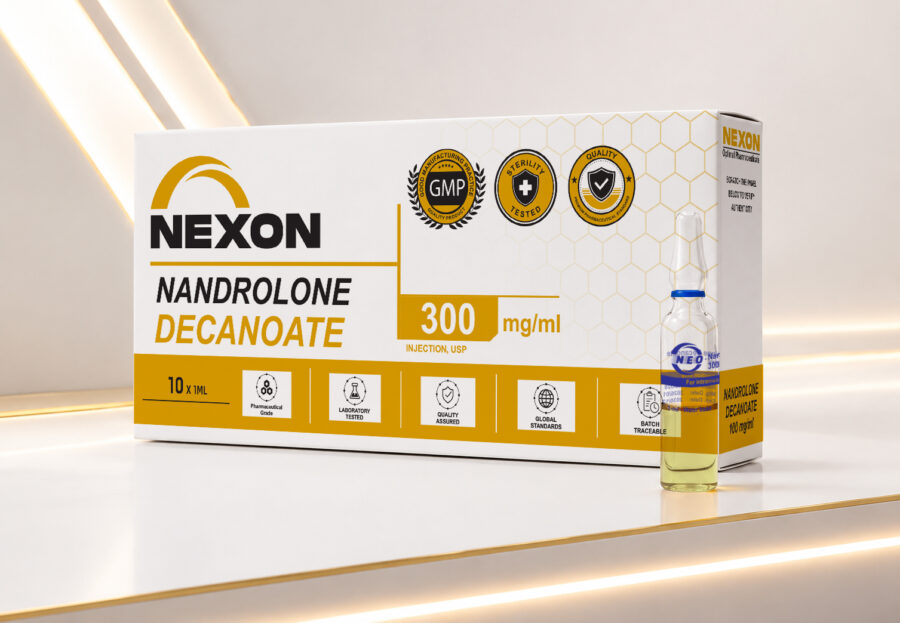
Nandrolone Decanoate
Nandrolone Decanoate is a long-acting esterified form of nandrolone developed to provide prolonged release following intramuscular administration.Nandrolone is a synthetic anabolic…
- Dosage Form / Route Intramuscular Injection
- Drug Class Anabolic Androgenic Steroid (AAS)
Product Specifications
| Dosage Form / Route | Intramuscular Injection |
|---|---|
| Composition | Nandrolone Decanoate (C₂₈H₄₄O₃) |
| Indications | conditions associated with protein catabolism under medical supervision |
| Drug Class | Anabolic Androgenic Steroid (AAS) |
| CAS Number | 360-70-3 |
| Chemical Formula | C₂₈H₄₄O₃ |
| Molecular Weight | 428.65 g/mol |
| Half-Life | Approximately 6–12 Days |
| Ester Type | Long-Acting Nandrolone Ester |
This page is for product information only. NEXON does not sell products online through this website.
Scientific Profile
Detailed information
Introduction
Nandrolone Decanoate is a long-acting esterified form of nandrolone developed to provide prolonged release following intramuscular administration.Nandrolone is a synthetic anabolic androgenic steroid structurally related to testosterone but characterized by the absence of a carbon atom at the 19th position, resulting in the designation 19-nortestosterone.The decanoate ester increases the lipophilicity of nandrolone, producing slower absorption from the injection site and sustained hormone availability over an extended period.Compared with shorter nandrolone esters, Nandrolone Decanoate provides prolonged pharmacokinetic activity with gradual release into systemic circulation.Its unique anabolic-to-androgenic profile has made Nandrolone Decanoate one of the most extensively studied anabolic steroid compounds in clinical medicine and pharmaceutical research. NEXON
History
The discovery of nandrolone represented an important advancement in anabolic steroid research during the mid-twentieth century.
Scientists developed nandrolone by modifying the testosterone molecule through removal of the carbon atom at the 19th position, creating a compound with distinct anabolic and androgenic characteristics.
Subsequent esterification with decanoic acid produced Nandrolone Decanoate, allowing prolonged therapeutic activity following intramuscular administration.
Nandrolone Decanoate has been investigated for multiple medical applications involving protein metabolism, bone physiology, and red blood cell production.
Scientific investigation of nandrolone contributed significantly to advances in:
- Anabolic steroid pharmacology
- Protein metabolism
- Bone physiology
- Clinical endocrinology
- NEXON
Chemical Structure
Nandrolone Decanoate consists of the nandrolone molecule esterified with decanoic acid at the 17-beta hydroxyl position.
The esterification process modifies pharmacokinetic behavior without altering the biological activity of nandrolone after enzymatic hydrolysis.
- The decanoate ester primarily influences:
- Absorption rate
- Release duration
- Plasma availability
- Pharmacokinetic characteristics
Following enzymatic cleavage of the ester bond, free nandrolone becomes biologically active and interacts with androgen receptors in multiple tissues. NEXON
Pharmacology
Following intramuscular administration, Nandrolone Decanoate forms a long-lasting depot within muscle tissue.
The decanoate ester undergoes gradual enzymatic hydrolysis, releasing free nandrolone into systemic circulation over an extended period.
Once released, nandrolone interacts with androgen receptors located throughout numerous tissues including:
- Skeletal muscle
- Bone
- Bone marrow
- Connective tissue
- Skin
- Liver
- Reproductive tissues
Nandrolone also undergoes metabolic conversion into biologically active metabolites.
Conversion Pathway Enzyme Product Nandrolone → DHN 5-alpha reductase Dihydronandrolone Nandrolone → Estradiol Aromatase Estradiol (Low Rate)
NEXON
Mechanism of Action
Nandrolone produces its biological effects primarily through activation of intracellular androgen receptors.
- The biological process includes:
- Nandrolone enters target cells.
- Nandrolone binds to androgen receptors.
- The receptor-hormone complex becomes activated.
- The activated complex translocates into the cell nucleus.
- Interaction with androgen response elements occurs on DNA.
- Gene transcription is regulated.
- Cellular protein synthesis and tissue-specific physiological responses are influenced.
- Activation of androgen receptors contributes to:
- Protein synthesis
- Nitrogen retention
- Muscle tissue maintenance
- Bone remodeling
- Red blood cell production
- Connective tissue physiology
- Endocrine regulation
NEXON
Pharmacodynamics
Nandrolone Decanoate affects multiple physiological systems through androgen receptor signaling.
NEXON
Pharmacokinetics
Following intramuscular administration, Nandrolone Decanoate forms a long-lasting depot within muscle tissue.
The decanoate ester undergoes gradual enzymatic hydrolysis, releasing free nandrolone into systemic circulation over an extended period.
Compared with shorter nandrolone esters, Nandrolone Decanoate provides prolonged hormone availability and sustained pharmacokinetic activity.
NEXON
Physiological Effects
Normal nandrolone activity contributes to:
- Muscle Function
- Protein synthesis
- Nitrogen retention
- Maintenance of lean body tissue
- Muscle physiology
- Bone Health
- Bone remodeling
- Mineral density maintenance
- Skeletal integrity
Clinical Applications
Nandrolone Decanoate may be used under medical supervision for selected medical conditions when clinically indicated.
- Clinical evaluation may include:
- Medical history
- Physical examination
- Laboratory assessment
- Individual therapeutic evaluation
- Potential medical applications include:
- Selected anemia disorders
- Osteoporosis
- Conditions associated with protein catabolism
- Selected chronic disease management
NEXON
Safety Considerations
Nandrolone therapy requires individualized medical evaluation and regular monitoring.
Important considerations include:
- Cardiovascular health
- Blood parameters
- Endocrine function
- Liver and kidney function
- Lipid profile
- Individual therapeutic response
NEXON
Potential Adverse Effects
Possible adverse effects may include:
- Endocrine Effects
- Suppression of endogenous testosterone production
- Hormonal imbalance
- Alterations in endocrine function
- Dermatological Effects
- Acne
- Increased skin oil production
- Hair loss in genetically predisposed individuals
- Cardiovascular Effects
- Changes in lipid profile
- Increased hematocrit
- Fluid retention
- Reproductive Effects
- Reduced fertility
- Suppression of spermatogenesis
- Hormonal suppression
NEXON
Contraindications
Condition Reason Prostate Cancer Potential androgen sensitivity Male Breast Cancer Hormone-sensitive condition Pregnancy Risk of fetal virilization Severe Untreated Medical Conditions Requires medical evaluation Known Hypersensitivity Risk of allergic reaction
NEXON
Drug Interactions
Potential interactions may occur with:
Anticoagulants Nandrolone may influence anticoagulant response and require monitoring.
Antidiabetic Medications Changes in glucose metabolism may alter therapeutic requirements.
Corticosteroids Combined administration may increase fluid retention.
Other Hormonal Therapies Combined hormonal therapy requires professional medical supervision.
NEXON
Laboratory Monitoring
Laboratory Test Purpose CBC Assess blood parameters
Hematocrit Monitor red blood cell concentration
Hemoglobin Evaluate erythropoiesis
Liver Function Tests Assess hepatic health
Kidney Function Tests Evaluate renal function
Lipid Profile Monitor cardiovascular risk markers
Total Testosterone Evaluate endocrine status
Estradiol (E2) Assess estrogen balance
PSA (When Appropriate) Monitor prostate health
NEXON
Storage & Stability
- Store according to official product labeling.
- Protect from excessive heat and direct sunlight.
- Do not freeze.
- Maintain original packaging integrity.
- Keep away from children.
- Inspect packaging before use.
NEXON
Product Authenticity
Every genuine NEXON product should include appropriate quality verification features.
Authentication may include:
- Batch number tracking
- Manufacturing information
- Expiration date verification
- QR authentication system
- Authorized distribution verification
emphasizes transparency, traceability, and product quality control.
NEXON
Frequently Asked Questions
What is Nandrolone Decanoate? Nandrolone Decanoate is a long-acting esterified form of nandrolone designed to provide sustained hormone release following intramuscular administration.
How is Nandrolone Decanoate different from Nandrolone Phenylpropionate? Nandrolone Decanoate provides a slower release profile and longer duration of activity, whereas Nandrolone Phenylpropionate produces a faster onset with a shorter duration.
What is the active hormone released after ester hydrolysis? After enzymatic cleavage, the active hormone released is nandrolone (19-nortestosterone).
Why are nandrolone esters used? Esterification modifies the pharmacokinetic profile of nandrolone by controlling hormone release and extending biological activity.
Is Nandrolone Decanoate identical to testosterone? No. Nandrolone is a structurally modified androgen derived from testosterone by removal of the carbon atom at the 19th position, resulting in distinct pharmacological properties. NEXON
Quality Commitment
is committed to maintaining the highest standards of manufacturing quality, product consistency, traceability, and scientific integrity.
Through advanced quality control systems, authentication technologies, and evidence-based pharmaceutical development, NEXON strives to provide reliable products supported by scientific transparency and regulatory standards.
NEXON
Related
More in this category
Nandrolone Phenylpropionate (NPP)
Nandrolone Phenylpropionate (NPP) is a short-acting esterified form of nandrolone developed to provide rapid hormone availability following intramuscular administration.Nandrolone…
Testosterone + Trenbolone Blend
Testosterone + Trenbolone Blend is a combination formulation containing testosterone and trenbolone-derived anabolic- androgenic steroid components.Testosterone is the principal en…
Nandrolone Phenylpropionate
Nandrolone Phenylpropionate (NPP) is a short-acting esterified form of nandrolone developed to provide rapid hormone availability following intramuscular administration.Nandrolone…